1. Prepositions of place.
Where is the object in relation to the house(s)? Match the pictures to the prepositions.
|
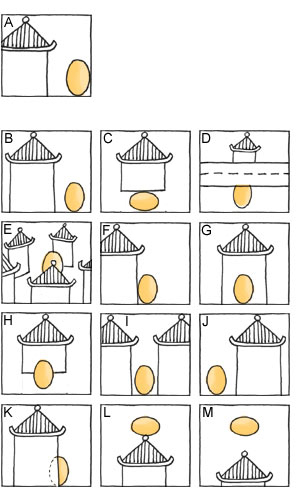 |
4. Prepositions of place.
Use the prepositions in the box below to complete these sentences from the feng shui article.
Now listen to how these words are pronounced.
5. Moving house.

The Johnson family are moving house. Mrs Johnson wrote a note to the removal men which explains where to put all the furniture.
Read the note and then follow Mrs Johnson's instructions. Put the furniture in the correct room.
Dear removal men,
Here's a little note to help you put all the furniture in the house – it should be quite easy, really. First the living room – this is the room next to the kitchen. The bookcase and the sofa go in here. Just leave them in the middle of the room.
The cupboard goes in the kitchen. So does the electric fire. Put them in the middle of the room – I'll sort them out later.
The mirror and the shelves go in the bathroom. Put them on the floor for the time being.
The bedroom is next to the bathroom. The table, wardrobe and bunk beds go here. Leave them in the middle of the room.
One thing I forgot – the plant goes in the bathroom. Oh, and the rocking chair! Put that in the living room.
I think that's the lot.
Thanks very much,
Alison Johnson

7. Sentence completion.
Match the first parts of the sentences from the previous exercise on the left with the second parts on the right.
What's the difference between might and will? Check in the Grammar Reference.
8. Giving advice.
| imperative | or | something | might will/won't |
happen |
| Take an umbrella | or | you | might |
get wet. |
Match the parts of the sentences below.
9. Can you remember?
Look at the sentences in exercise 6 for two minutes. Can you remember and complete them below?
10. Giving advice: Conditional sentences.
Don't leave your bike there or someone might fall over it.
We can also use a conditional sentence.
If you leave your bike there, someone might/will fall over it.
If + present, might/will + verb
Here is another example:
Post that letter today or it won’t arrive on time.
Or:
If you don’t post that letter today, it won’t arrive on time.
Put the words in order to make more conditional sentences like the examples above.